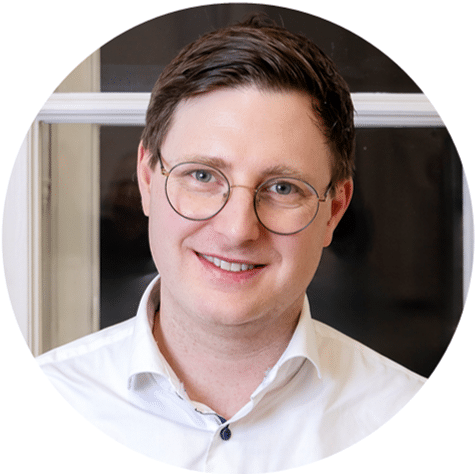
Matthias joined EBW back in 2011 and was the „substructure“ guy from the very first day. He was part of the big „gen I“ team setting up the so called Life Cycled Management process answering the question of the optimal point in time for a track renewal. His PhD thesis published in the institute’s monographic research series as „Smart data for sustainable Railway Asset Management“ was finished in 2016. He stayed at the institute as post-doc researcher establishing a new research area focussing on environmental impacts and circular economy in the railway system. After achieving habilitation in 2022, he founded evias rail.
When you think back to your time at the institute – what’s the first thing that comes to mind?
Joy, friendships, hard work – I really enjoyed my time at the Institute, meeting railway professionals from all over the world and working closely with people who became friends on forward-thinking and relevant topics. I also enjoyed passing on knowledge to younger colleagues, whether as a lecturer or within the Institute.
What was the reason for starting at the EBW? Did it live up to your expectations?
As a student, I became fascinated by the railway-related courses, so I decided to write my master’s thesis with Stefan (Marschnig). That is how everything developed from there. Before that, I could not have imagined how interesting, diverse and thriving the railway sector is, especially in Austria. EBW is a very important part of that environment, and it therefore exceeded my expectations by far.
How did what you learned during your degree and at the institute help you when you started your career and in your subsequent career?
I learned that there is always a solution to any challenge. My time at the Institute taught me how to gather information and knowledge, and how to apply it in studies and projects. What stayed with me is to never give up, but to start step by step, even when the task ahead – such as a PhD or a habilitation – seems overwhelming at first. I also learned how important it is to understand which information or statistical analyses can be trusted, and which questions need to be asked in order to verify them – a skill that has become, and will continue to become, even more important in the future.
Are you still in touch with your former colleagues? Professionally or privately?
Yes, definitely both. Since many pre-docs are at a similar age and phase of life, and since we travelled a lot together for conferences and international projects, we quickly became more than just colleagues.
Do you have any advice for current PhD students at the EBW?
Don’t hesitate to make use of all the possibilities the Institute and life in academia in general has to offer. At the beginning, just after finishing my master’s degree at university, I sometimes felt a bit overwhelmed when I had the possibility to present at a major conference or share my results in an important meeting. But I always said, “Yes, of course, I’d like to do it.” That helped me grow a lot, not only professionally.